
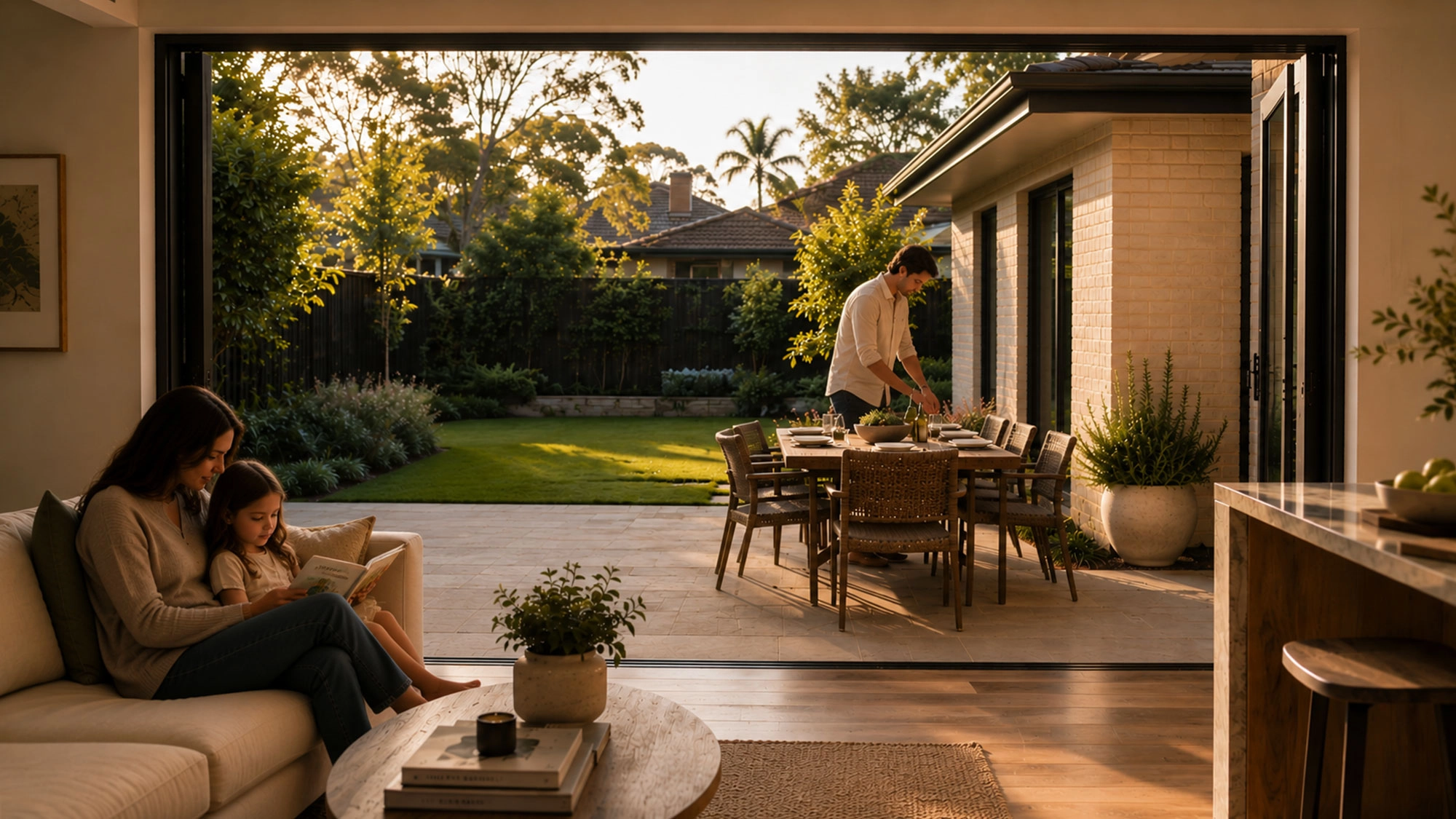
A home renovation and a landscape project are often treated as two separate projects.
One focuses on the house. The other focuses on the garden.
They’re frequently planned at different times, involve different professionals and are sometimes even separated by months or years.
The interesting thing is that once they’re complete, nobody experiences them as two projects.
You don’t enjoy the kitchen separately from the courtyard beyond it. You don’t think about the deck independently from the living room it connects to. You simply experience your home as one integrated environment.
That’s why the timing of landscape decisions matters.
Many of the decisions that shape the future outdoor environment are made while the house is still being planned. By the time construction is complete, some of the greatest opportunities to create a cohesive home have already passed. Landscape planning during renovation is a key moment in deciding how your home will feel.

House and garden are experienced as one
Although the house and landscape may be designed through different processes and built by different people, they ultimately work together to shape the function and experience of your property.
How you move between inside and outside, where you entertain, how private your outdoor spaces feel, the outlook from your living areas and the way the garden supports everyday life all depend on the relationship between the house and its surroundings.
When those decisions are considered together, the result often feels effortless.
When they’re considered separately, the landscape can find itself adapting to decisions that have already been made.
This isn’t necessarily a problem, but it usually means fewer options and greater compromise.
Why timing matters
Many homeowners understandably think about the landscape once the renovation is complete. The builders have finished, the scaffolding has gone and attention finally turns to the garden.
The challenge is that many of the decisions affecting the outdoor environment have already been made.
That’s because many of those decisions are made as part of the house project, even though they directly influence the future landscape.
Finished floor levels, door locations, drainage, retaining walls, the location of services, outdoor entertaining areas and access all influence what becomes possible outside.
Once these decisions have been built, changing them can become expensive, disruptive or simply impractical.
Imagine discovering after the house has been built that you can’t install the pizza oven you’d imagined because there isn’t enough separation from the house. Or finding there’s no room for even a modest swimming pool because underground services occupy the only suitable location. Or realising every time you step outside from the kitchen you need to negotiate a step because the relationship between the internal and external floor levels was never considered.
Considering these relationships earlier gives you more options while the project is still relatively flexible.

Define before you design
Successful landscape projects don’t begin with selecting plants or deciding where a path should go. They begin by understanding the relationship between the people, the place and the project.
Before deciding on solutions, it’s worth asking broader questions.
- How do you want to use the outdoor space?
- How should the house connect with the garden?
- Where does the site receive sun and shade?
- Which views should be enhanced or screened?
- What opportunities and constraints already exist?
This is the Define stage.
Its purpose is to reduce uncertainty before important decisions are made.
Only once the project has been clearly defined does it move into Design.
Different possible responses are evaluated against the project’s objectives, site conditions, opportunities, constraints, budget and long-term performance. Through professional judgement, these competing considerations are resolved into a single recommended response.
Finally, Deliver brings that agreed recommendation to life through construction.
Thinking about the process this way explains why many of the most valuable landscape decisions happen before construction begins rather than after it.
What happens when landscape decisions come too late?
Delaying landscape thinking doesn’t automatically lead to a poor outcome.
Many renovations still produce excellent gardens.
However, leaving important outdoor decisions until after the renovation often means working within constraints that could have been avoided.
You may discover there isn’t enough space for the entertaining area you imagined.
Existing drainage may limit planting opportunities. A retaining wall might now be unavoidable because floor levels were established without considering the surrounding landscape. Outdoor lighting, irrigation or services may require unnecessary excavation after the renovation has already been completed.
These aren’t mistakes.
They’re simply opportunities that become harder to realise once earlier decisions have already been built.

When should you seek professional advice?
If your renovation is still in the planning stage, this is often the most valuable time to seek professional landscape advice.
Not because the landscape needs to be designed immediately, but because this is when many of the decisions that shape the outdoor environment are still flexible.
Professional advice at this stage helps ensure the house and landscape are considered together, before key aspects of the project become expensive or difficult to change.
Sometimes the most valuable first step is understanding the site, clarifying your objectives and identifying how the outdoor environment can support the renovation before major decisions are locked in.
As the project becomes more clearly defined, landscape design resolves those opportunities into a recommended response. Once everyone understands what is being built and why, construction can proceed with confidence, knowing the project is working towards a clearly defined outcome.
The goal isn’t to deliver two successful projects. It’s to create one connected home.

So, when should you start thinking about the landscape?
The best time to begin thinking about your landscape is while you’re still making important decisions about your renovation.
Planning early doesn’t commit you to immediate construction, nor does it mean every detail needs to be resolved from the outset.
It simply gives you the opportunity to make informed decisions while the project is still flexible.
People may plan two projects, but they experience one home.
The earlier those decisions are considered together, the greater the opportunity to create an outdoor environment that feels like a natural extension of the way you live.
FAQs
When should I start planning my landscape during a home renovation?
The best time is while your renovation is still being planned. Many of the decisions that shape the outdoor environment—such as floor levels, drainage, services and access—are made before construction begins. Considering the landscape early provides greater flexibility and helps create a more integrated home.
Do I need a landscape design before renovating my house?
Not always. However, seeking landscape advice during the planning stage can help ensure important outdoor decisions are considered before they become expensive or difficult to change. A complete landscape design can then be developed when the project is appropriately defined.
Why should the house and garden be planned together?
Although they are often treated as separate projects, the house and garden are experienced as one home. Planning them together helps improve connections between indoor and outdoor spaces while reducing unnecessary compromises later in the project.
Can landscape planning save money during a renovation?
Considering landscape decisions early can help identify opportunities and constraints before construction begins. This may reduce the need for expensive changes or rework later in the project.
What happens if I leave the landscape until after the renovation?
Many renovations still achieve excellent outdoor spaces. However, delaying landscape planning can mean working within constraints that could have been avoided, reducing flexibility and limiting future opportunities.
Every successful renovation is shaped by hundreds of decisions.
Some affect the house. Others affect the landscape.
Many influence both.
Considering them together while your project is still flexible helps create a home that functions as a connected whole rather than two separate projects.
If you’re planning a renovation and want to understand how your outdoor environment can support the way you live, a landscape consultation provides the clarity needed to make informed decisions before construction begins. As one of our many services a landscape consultation can be a good first step prior to significant investment

Book a landscape consultation today