
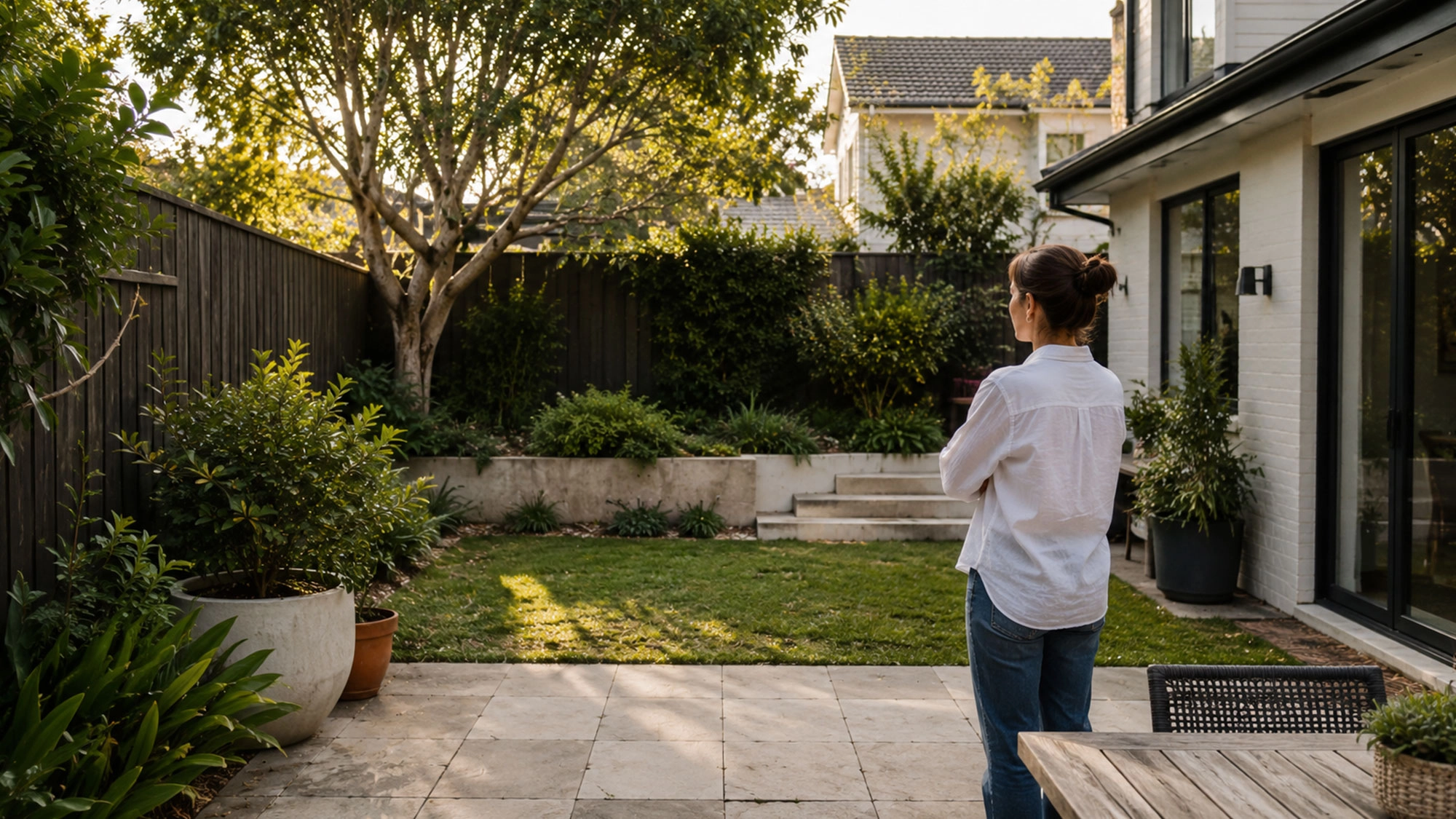
Looking to hire a landscaper?
Most homeowners don’t begin a garden project by thinking about the problem they’re trying to solve. They begin by thinking about the solution.
“I need paving.”
“I need a retaining wall.”
“I need new planting.”
Or perhaps most commonly:
“I need a landscaper.”
Sometimes that’s exactly the right next step.
Successful landscape projects, however, often begin by reducing uncertainty before committing to a solution.
Other times, the most valuable investment isn’t construction – it’s understanding the problem well enough to decide what should be built in the first place.
The question isn’t simply whether you need a landscaper.
The question is whether you’ve reached the stage where construction is the right next step.

Most Successful Landscape Projects Follow Three Stages
Every landscape project is different, but many successful projects follow a similar progression.
First, the project is defined.
Then it is designed.
Finally, it is delivered.
When deciding who to speak to first, it can be helpful to begin by considering where your project currently sits within that process.
Define
The Define stage is about understanding before deciding.
This is where homeowners clarify what they want to achieve, understand the opportunities and constraints of the site, identify priorities and consider different ways of solving the problem.
The purpose of the Define stage isn’t to make immediate decisions.
It’s to create clarity.
Understanding the site, your objectives and the different ways they might be achieved gives you the confidence to make better decisions as the project progresses.
For example, a family may feel their backyard isn’t working because it lacks usable outdoor space.
At this stage, it isn’t yet important whether the solution is paving, decking, retaining walls or planting.
The important question is why the space isn’t working and what outcomes the project needs to achieve.
Good decisions usually begin with good questions.
Design
Once a project has been clearly defined, attention turns to resolving the best way forward.
This is where uncertainty gives way to direction.
Different possible responses are evaluated against the project’s
objectives, site conditions, opportunities, constraints, budget and long-term performance. Through professional judgement, these competing considerations are resolved into a single recommended response.
The goal isn’t simply to produce drawings.
The goal is to confidently determine the most appropriate response
before construction begins.
Deliver
Only once the preferred solution has been established does the project
move into delivery.
Construction transforms the agreed recommendation into a finished landscape.
This is where practical skills, craftsmanship, coordination and construction expertise become critical to achieving a successful
outcome.
Construction is where ideas become reality.

Where Does a Landscaper Fit?
Landscapers play an essential role in bringing outdoor spaces to life.
Their expertise lies in construction, implementation and coordinating the many elements required to deliver a completed landscape.
If your project has already been carefully considered, the scope is well defined and you’re confident about what you want to build, engaging a landscaper may be exactly the right next step.
Where Does a Landscape Consultant Fit?
A landscape consultant typically works much earlier in the process.
Rather than beginning with a predetermined solution, the conversation begins with understanding.
The purpose isn’t to delay construction.
It’s to reduce uncertainty and provide the clarity needed to make informed decisions before committing to a particular solution.
Where Does a Landscape Designer Fit?
Landscape designers typically lead the Design stage.
Their role is to apply professional judgement to everything that has been learned during Define, resolving competing priorities into a recommendation that best responds to the project as a whole.
Rather than simply documenting ideas, they provide a clear direction for the project and a shared understanding of what will be built and why.
Once the design has been finalised and the documentation prepared, construction can begin with confidence, knowing everyone is working towards a clearly defined outcome.

What Happens When Projects Skip the Define Stage?
Imagine a homeowner with a sloping backyard.
They decide they need a retaining wall.
A landscaper is engaged, the wall is built and the project is completed to a high standard.
Only afterwards do they realise the wall has reduced usable planting space, altered drainage patterns or created privacy issues they hadn’t anticipated.
The retaining wall wasn’t necessarily the wrong solution.
Nor was it poorly built.
The project simply began with a solution rather than fully understanding the problem.
On another site, the same objective might have been achieved through terracing, changes to the garden layout or a combination of smaller interventions.
Those possibilities are usually considered before construction begins, not during it.

So… Should You Hire a Landscaper First?
Sometimes.
If the project has already been carefully considered and you’re confident about what needs to be built, a landscaper may be exactly the right first call.
If you’re still working out what’s possible, balancing competing priorities or trying to understand the opportunities and constraints of your site, seeking professional advice before construction begins can help reduce uncertainty and lead to more informed decisions.
The right first conversation depends less on the type of work you hope to build and more on where you are in your project.
Which Professional Should You Speak To?
| If you’re here… | Your next conversation is probably with… |
|---|---|
| I know exactly what I want / need built. | Landscaper |
| I know something isn’t working, but I’m not sure why. | Landscape Consultant |
| I need a recommended solution developed into a buildable proposal. | Landscape Designer |
| I need specialist construction advice. | Appropriate specialist contractor |
Wrap Up
Every successful landscape project begins somewhere.
For some homeowners, that starting point is construction because the problem has already been clearly defined and the preferred solution is understood.
For others, the most valuable first step is reducing uncertainty – understanding the site, clarifying priorities and determining what will best achieve the outcome they’re looking for.
The question isn’t simply whether you should hire a landscaper first.
It’s whether you’ve reached the stage where construction is the right next step.
By understanding where your project sits within the Define → Design → Deliver framework, you can engage the right expertise at the right time, make more informed decisions and move into construction with confidence, knowing everyone is working towards a clearly defined outcome.
FAQs
Should I hire a landscaper before getting a landscape design?
Not always.
If you already know exactly what you want to build and you’re confident the project has been carefully considered, a landscaper may be the right first call.
If you’re still defining the problem, understanding site constraints or weighing different responses, developing a clear recommendation before construction can help you make more informed decisions.
What’s the difference between a landscaper and a landscape designer?
A landscape designer helps determine what should be built by evaluating the site’s opportunities and constraints alongside your objectives and priorities.
A landscaper brings that agreed recommendation to life through construction and implementation.
Many successful projects involve both, each contributing their expertise at different stages.
What does a landscape consultant do?
A landscape consultant helps reduce uncertainty before important decisions are made.
This usually involves understanding your objectives, assessing the site, identifying opportunities and constraints, and recommending the response that best aligns with your project.
The goal isn’t to delay construction—it is to begin construction with greater confidence.
Do I need a landscape design before getting construction quotes?
Not always.
If the scope of work is already well defined, you may be ready to seek construction quotes.
However, if key decisions are still unresolved, developing a clear recommendation first can make it easier to compare quotes, communicate your expectations and ensure contractors are pricing the same project.
Can a landscape consultation save money?
A landscape consultation may help identify opportunities, constraints and alternative responses before construction begins.
Making informed decisions early can help avoid expensive changes later in the project and gives you greater confidence that you’re investing in the most appropriate solution.
Every successful landscape project begins somewhere.
Sometimes that starting point is construction.
Sometimes it’s taking the time to better understand the site, clarify your objectives and determine the most appropriate response before work begins.
If you’re still deciding what your outdoor space needs, a landscape consultation can help reduce uncertainty, provide a considered professional recommendation and give you the confidence to move into construction knowing everyone is working towards a clearly defined outcome. With a range of services for every landscape problem Jasper Green can help you understand the right next move to achieve a landscape that you love.

Book a Discovery Call to discuss how your project could benefit from our expertise.