
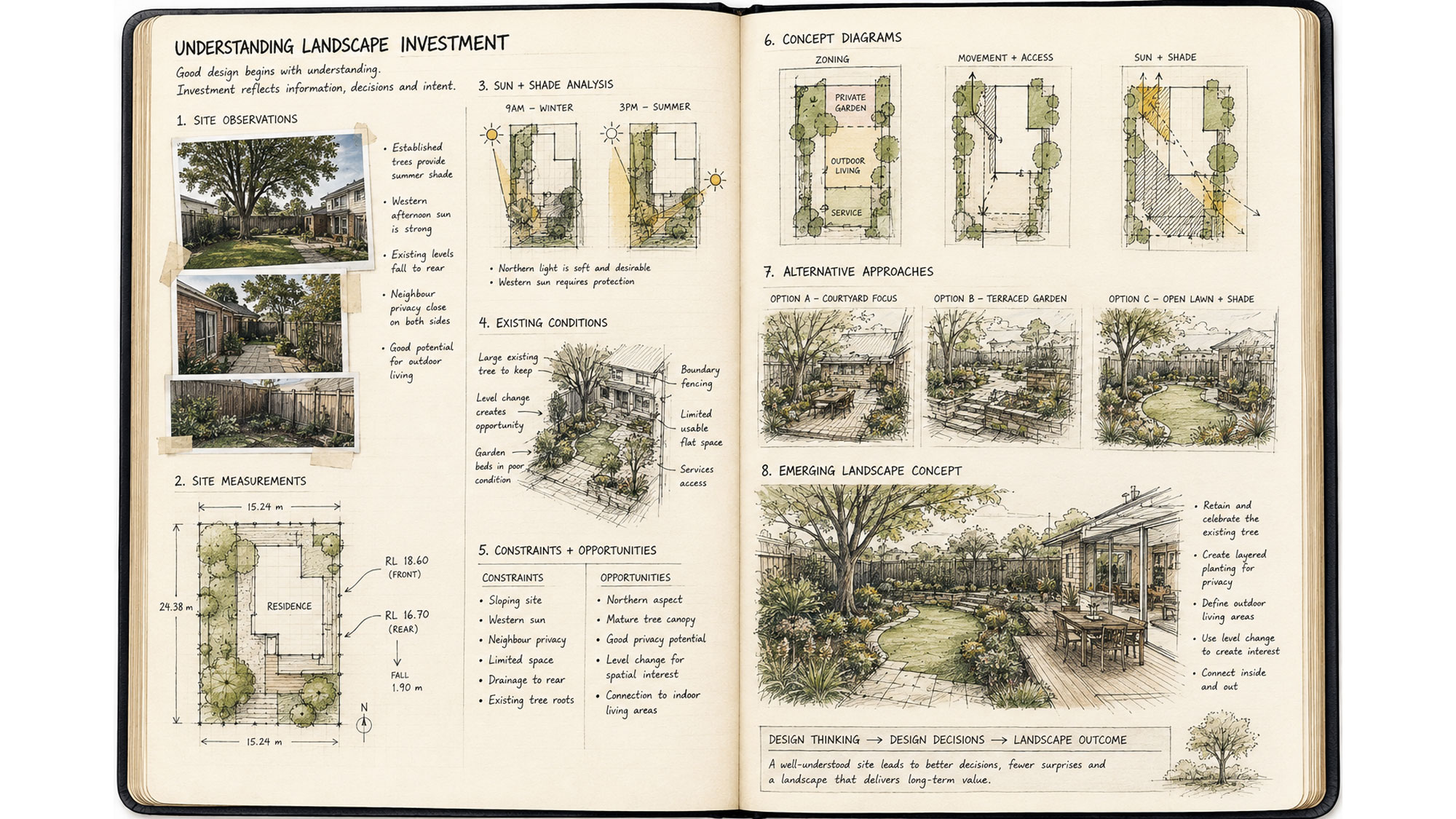
Landscape design costs in Sydney: what influences the investment?
Most homeowners begin researching landscape design costs in Sydney looking for a simple answer.
How much should a landscape project cost? Why does one proposal differ significantly from another? Is professional advice really worth the investment?
The difficulty is that landscape projects rarely fit neatly into a pricing guide.
Two properties may have similarly sized outdoor spaces yet require very different levels of planning, coordination and decision-making. Likewise, two households with similar sites may have entirely different priorities, expectations and long-term goals.
As a result, landscape investment is rarely determined by size alone.
More often, it emerges from the interaction between four factors:
- The site.
- The project brief.
- The complexity of the project.
- The level of clarity required before construction begins.
Understanding how these factors work together can help homeowners make better decisions and reduce the likelihood of costly surprises later in the project.

Why Landscape Investment Varies
Many discussions about landscape costs focus on area.
Larger sites are assumed to require larger budgets, while smaller sites are assumed to be simpler and therefore less expensive.
In practice, the relationship is rarely that straightforward.
A compact courtyard may need to accommodate privacy, entertaining, storage, planting and circulation within a limited footprint. A much larger garden may require relatively few changes and involve far fewer competing priorities.
Similarly, two homeowners may approach the same site with entirely different objectives. One may be seeking a modest refresh of planting and materials. Another may be looking to reconfigure how the outdoor space functions as part of a broader property renovation.
The difference is not necessarily the size of the site.
The difference is the number of decisions that need to be made, the constraints that need to be resolved and the level of clarity required before construction begins.
This is why landscape investment can vary significantly even between projects that appear similar at first glance.
The Site and the Brief
Successful landscapes emerge from the relationship between a site and the people who use it.
Neither exists in isolation.
Every site presents its own opportunities and constraints. Sunlight, drainage, topography, access, existing vegetation and planning controls all influence what is realistically achievable.
At the same time, every household brings its own requirements.
A family may need space for children to play. A couple may prioritise entertaining. Another homeowner may be seeking privacy, low maintenance or stronger connections between indoor and outdoor living spaces.
None of these objectives are inherently more complex than the others.
However, each introduces different decisions, trade-offs and planning considerations.
A level courtyard with straightforward objectives may require relatively little intervention. The same courtyard may become considerably more complex if it is expected to support outdoor dining, productive planting, privacy screening, storage and future lifestyle changes simultaneously.
The site has not changed.
The brief has.
This interaction between site conditions and project objectives is often one of the most significant influences on landscape investment.
What Are You Actually Investing In?
One of the most common misconceptions is that professional fees are primarily paying for outputs such as plans and drawings. In reality, drawings are often the resolution of a much larger process. Before documentation is prepared, time is spent understanding the site, clarifying priorities, identifying constraints and exploring possible approaches.
Opportunities need to be evaluated. Conflicts need to be resolved. Trade-offs need to be understood.
The focus is ultimately on outcomes rather than outputs.
A homeowner may want more privacy without sacrificing sunlight. Greater planting without losing usable space. Additional functionality without creating visual clutter.
These decisions are rarely resolved by a drawing alone. They are resolved through analysis, planning and informed decision-making. The goal is not simply to produce documentation. The goal is to establish a clear direction, reduce uncertainty and provide confidence that future decisions are aligned with both the site and the project’s objectives.
In many cases, the most valuable outcome is not the plan itself, but the clarity that emerges through the process of developing it.
Constraints and Complexity
The interaction between a site and a project brief often determines the level of complexity involved.
Some constraints are immediately visible. Others only become apparent once the site and objectives are considered together.
A homeowner may wish to create a larger entertaining area. On one property, that may be relatively straightforward. On another, it may be influenced by existing trees, drainage requirements, privacy concerns or planning controls.
Similarly, a desire for greater privacy may appear simple in principle. In practice, achieving it may involve balancing screening, sunlight, outlook, airflow and the relationship between the property and the street.
This is where complexity often emerges.
Not because any individual requirement is unreasonable, but because multiple requirements must work together within the realities of a particular site.
Planning controls can add another layer of complexity.
In established Sydney suburbs, considerations such as heritage controls, streetscape character, tree protection requirements, deep soil zones and minimum landscaped area provisions may influence what is achievable and how a project is approached.
These constraints do not necessarily prevent change. However, they often shape the range of viable options available.
The more constraints and objectives that need to be reconciled, the greater the level of coordination and decision-making required.

Landscapes Are Systems
One of the reasons landscape projects benefit from careful planning is that individual decisions rarely exist in isolation.
Landscapes function as systems of interconnected elements.
Planting influences privacy and shade. Shade influences how outdoor spaces are used. Circulation influences furniture placement. Furniture placement influences available planting space. Changes to drainage can affect paving, levels and access.
A decision made in one area of a project often influences several others.
For example, relocating a privacy screen may improve views from the house, but it may also affect planting opportunities, sunlight, circulation and the overall sense of enclosure within the space.
Similarly, adjusting levels to improve drainage may influence paving layouts, retaining requirements, accessibility and how different parts of the landscape connect together.
This interconnectedness is one of the reasons seemingly simple decisions can become surprisingly complex.
The objective of planning is not to predict every eventuality. Rather, it is to understand how different parts of the landscape interact so that decisions can be evaluated within the context of the whole site.
Many costly project changes occur not because a decision was wrong, but because its wider implications were not fully understood when it was made.
Viewed this way, professional advice is often less about producing plans and more about understanding relationships between decisions before construction begins.

The Value of Early Decision-Making
One of the benefits of a structured planning process is that many important decisions can be explored while they are still relatively inexpensive to change.
During planning, ideas can be tested, assumptions challenged and potential conflicts identified before construction begins.
A proposed privacy screen may affect sunlight. A paving layout may influence drainage. A planting area may compete with circulation or entertaining space. These issues are often easier to identify and resolve when they exist as ideas rather than completed construction.
This is not about predicting every possible outcome.
Landscape projects will always contain unknowns.
Rather, it is about identifying the most significant opportunities, constraints and decision points early enough that they can be considered within the context of the broader project.
Even during construction, unexpected issues can emerge. Existing site conditions may differ from assumptions. Practical considerations may require adjustments. Priorities may evolve as the project progresses.
When this occurs, a clear understanding of the site’s objectives, constraints and design intent provides a framework for making informed decisions.
In this sense, professional advice is often less about producing plans and more about helping clients navigate complexity throughout the life of a project.
The goal is not perfection.
The goal is to make informed decisions while they are still relatively easy to change.

Four Sydney Examples
Consider four hypothetical projects.
A terrace in Birchgrove may be relatively small, but expected to provide entertaining space, privacy, storage and generous planting within a limited footprint. The challenge is not size. It is balancing competing priorities.
A property in Hunters Hill may contain mature trees that influence construction access, future planting opportunities and the location of new works. Existing site conditions become a major consideration.
A renovation in Woollahra may involve heritage and streetscape considerations that influence how changes are approached and what approvals may be required.
A sloping site in Mosman may require careful coordination of drainage, retaining and circulation to ensure the landscape functions effectively over time.
Each project presents a different combination of site conditions, objectives, constraints and uncertainty.
None are necessarily larger than the others.
Yet each may require a very different level of planning before construction begins.
How Homeowners Can Improve Project Outcomes
The most successful projects often begin with understanding rather than assumptions.
Before seeking professional advice, it can be valuable to clarify both the site and the brief.
Questions worth considering include:
- What problems am I trying to solve?
- How do I want the landscape to function?
- What opportunities and constraints already exist?
- Which priorities are most important?
- How might my needs change over time?
The clearer these issues become, the easier it becomes to evaluate options and make informed decisions.
Good outcomes rarely emerge from a single feature, material or plant selection.
More often, they emerge from a series of considered decisions that align the site, the brief and the long-term goals of the project.
Wrap Up
There is no universal formula for landscape project investment.
While site size plays a role, it is rarely the most significant factor.
More often, investment is influenced by the interaction between site conditions, project objectives, complexity and the level of clarity required before construction begins.
A straightforward site with modest objectives may require relatively little planning. A small but highly constrained site with ambitious goals may require considerably more.
For this reason, two projects that appear similar on paper can involve very different levels of investment.
Ultimately, the most valuable outcome is often not a particular material, structure or plant.
It is the clarity that comes from understanding the site, defining the brief and making informed decisions before construction begins.
FAQ Section
Why do landscape project costs vary so much?
Landscape projects vary because every site presents different opportunities and constraints. Factors such as access, topography, drainage, existing trees, planning controls and project objectives can all influence the amount of planning and coordination required before construction begins.
Is landscape investment determined by the size of the site?
Not necessarily. While site size can influence costs, complexity is often a more significant factor. A small but highly constrained site may require more planning than a larger site with relatively few limitations.
What am I paying for when I engage a landscape consultant?
Professional fees generally cover more than plans and drawings. They also include site analysis, identifying opportunities and constraints, resolving conflicts, evaluating options and helping clients make informed decisions before construction begins.
Why is planning important before construction starts?
Many decisions are easier and less expensive to change during planning than during construction. Early planning can help identify potential issues, clarify priorities and reduce the likelihood of costly revisions later in the project.
Can a landscape plan eliminate all project risks?
No. Every project contains unknowns. However, a structured planning process can help identify significant risks, resolve key decisions early and provide a framework for managing issues that arise during construction.
Do I need a landscape plan for a small garden?
Small gardens often benefit from planning because limited space can magnify the consequences of design decisions. Even relatively simple projects can involve trade-offs between privacy, planting, circulation, entertaining and storage.
Need Clarity Before You Commit?
Every landscape project begins with a unique combination of site conditions, opportunities, constraints and client objectives.
Before making significant decisions, it can be valuable to understand how these factors interact and where the key trade-offs may exist.
A Jasper Green Site Diagnostic is designed to help homeowners identify opportunities, clarify priorities and understand potential constraints before committing to major landscape investment.
Whether you’re planning a courtyard renovation, a front garden transformation or a larger landscape project, early clarity can help reduce uncertainty and support better decision-making throughout the process.