
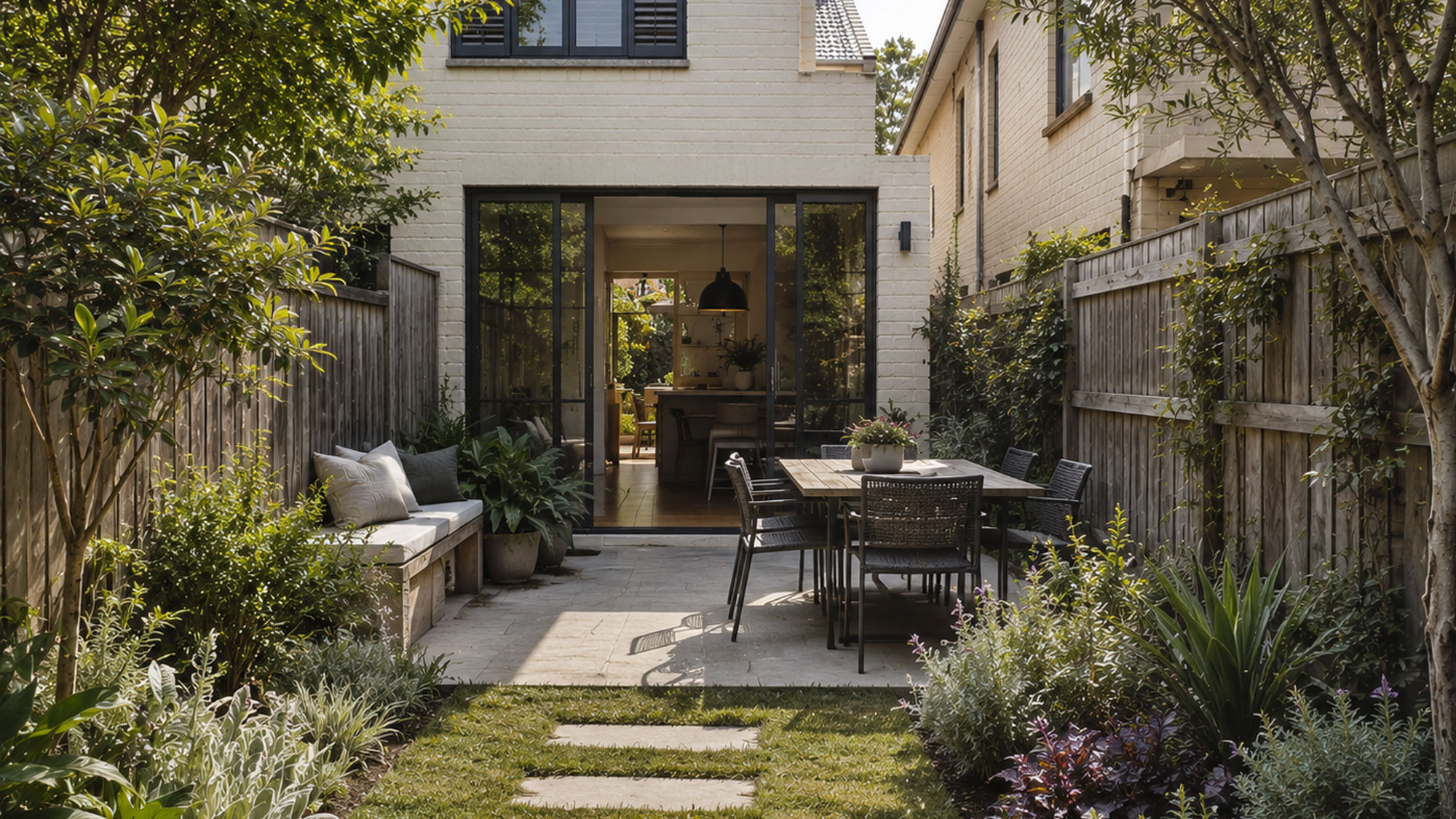
Many homeowners assume that small gardens are easier to design than large ones.

After all, there is less space to work with, fewer materials required and fewer decisions to make.
In practice, the opposite is often true.
Small gardens often need to accommodate multiple functions within a limited footprint. They may be expected to provide privacy, outdoor dining, planting, storage, circulation and visual appeal, all while responding to existing site conditions and planning constraints. In larger gardens, shortcomings can sometimes be absorbed by surplus space. In smaller gardens, every decision tends to have greater consequences.
In reality, small gardens often demand more careful decision-making because there is less room for mistakes.
As a result, when considering small garden design in Sydney, many disappointing outcomes are not the result of poor workmanship or poor plant selection. More often, they occur because important decisions are made before the site, priorities and long-term implications are properly understood.
Understanding some of the most common decision-making traps can help homeowners make better choices and avoid costly mistakes.
Every Small Garden Involves Trade-Offs
One of the realities of small garden design is that every project involves trade-offs.
Homeowners often want more privacy, more planting, more entertaining space and more storage. Unfortunately, limited space means these objectives can compete with one another.
A screen that improves privacy may reduce winter sunlight. Additional planting may create a greener outlook while leaving less room for entertaining. Even something as simple as increasing storage can affect how spacious a garden feels.
There is rarely a perfect solution that maximises every objective simultaneously. Successful small gardens are usually the result of carefully balancing competing priorities rather than attempting to optimise a single outcome.
Many of the common mistakes discussed below arise when these trade-offs are not recognised early in the design process.
1. Making Decisions Before Understanding the Site
One of the most common causes of disappointment is making design decisions before properly understanding the site.
Homeowners are often drawn to particular plants, materials or inspiration images before considering the conditions available. However, every site presents a unique combination of opportunities and constraints that should influence design decisions from the outset.
Factors such as aspect, sunlight, shade, wind exposure, drainage, access and existing structures can significantly affect what is likely to work successfully over time.
A compact rear garden in Balmain may present very different opportunities from a shaded courtyard in Glebe despite having a similar footprint. Likewise, a front garden in Hunters Hill may be influenced by streetscape considerations that do not apply elsewhere.
Site constraints are not limited to physical conditions. Planning controls, heritage considerations, deep soil requirements and minimum landscaped area provisions can also influence what is realistically achievable. In established Sydney suburbs, understanding these constraints early can help avoid pursuing solutions that may later prove impractical or difficult to approve.
Good design generally begins with understanding the site rather than imposing preconceived solutions upon it.
2. Trying to Solve Every Problem at Once
Small gardens are often expected to do a lot.
Homeowners may want a dining area, outdoor lounge, lawn, vegetable garden, storage, privacy screening, pet space and generous planting all within a relatively compact area.
Consider a typical terrace garden in Birchgrove. The owners may want space for weekend entertaining, somewhere for the dog, screening from neighbouring properties, bicycle storage and room for planting. Each requirement is reasonable on its own. The challenge arises when all of them must coexist within a relatively small footprint.
When too many objectives are pursued simultaneously, the result can become fragmented and cluttered. Instead of supporting several activities well, the garden may struggle to support any of them particularly effectively.
This issue commonly arises in small rear gardens and compact urban sites where space is limited but expectations remain high.
Successful projects often begin by identifying priorities. Determining what matters most allows space to be allocated deliberately rather than being divided between too many competing requirements.
In small gardens, prioritisation is often more important than inclusion.
3. Underestimating the Importance of Space
When space is limited, there can be a strong temptation to make every part of the garden work as hard as possible.
Homeowners often try to maximise functionality by incorporating additional planting, furniture, storage, decorative features or materials. While each individual addition may seem reasonable, the cumulative effect can make a small garden feel crowded and difficult to use.
This often happens when ideas are collected over time from magazines, social media, display gardens and well-meaning recommendations.
A common scenario is the gradual accumulation of features. A statement pot is added, followed by a bench seat, additional containers, decorative screening and several favourite plants. Individually, none of these elements is problematic. Together, they can leave a small garden feeling more constrained than before.
Visual clutter can also influence how a garden feels. Excessive materials, too many focal points or an overly complex planting palette can make a garden appear smaller than it actually is.
In contrast, some of the most successful small gardens rely on restraint. Limiting the number of materials, simplifying planting and preserving open space can improve both usability and the perception of spaciousness.
This does not mean small gardens should feel empty. Rather, it recognises that space itself is an important design element.
In many cases, what is left out of a small garden is just as important as what is included.

4. Treating the Garden as Separate Elements Rather Than a Whole
Many gardens evolve gradually.
New paving may be installed at one time, while furniture may be purchased later, and planting may be added over time. Privacy concerns may prompt the installation of screens several years after the original work is completed.
There is nothing inherently wrong with this approach. However, problems often arise when each decision is made independently.
A common example is when privacy becomes an issue after a neighbouring renovation. Screening is added to solve the immediate problem, only to later conflict with proposed planting, and impact furniture layouts or access routes.
A patio layout that appears reasonable on its own may limit future planting opportunities. Furniture selected without reference to circulation patterns may reduce functionality.
The result can be a collection of individually sensible decisions that fail to work cohesively together.
Gardens generally perform better when major decisions are considered as part of a broader framework. This does not necessarily require every detail to be implemented immediately, but it does benefit from an overall plan that guides future decisions.
5. Choosing Plants Before Establishing a Design Framework
Plant selection is often one of the first things homeowners think about.
Favourite plants, nursery visits and inspiration images frequently shape early ideas about a garden. Many projects begin with a list of favourite plants rather than a clear understanding of how the space needs to function.
Questions such as how the garden will be used, what level of maintenance is acceptable, how much sunlight is available and what privacy requirements exist are often more influential than the specific plants themselves.
Without this broader framework, plant selection can become disconnected from the needs of the site and the people using it.
This is particularly common in established suburbs such as Mosman, where homeowners may inherit mature gardens and begin by replacing individual plants without considering their suitability for the site. While new planting can improve a space, it rarely addresses broader questions about how the garden should function or what role it should play within the property.
Successful planting schemes are rarely the result of individual plant choices alone. More often, they emerge from a clear understanding of function, site conditions and long-term objectives.
Plants should support the overall design strategy rather than define it.
6. Solving One Problem While Creating Another
One of the most common sources of frustration in small gardens is discovering that a successful solution has created an entirely new problem.
A homeowner may install dense screening to improve privacy from an overlooking neighbour. The screening succeeds in blocking views, but it may also reduce winter sunlight, limit airflow and make the garden feel more enclosed. The original problem is solved, but new compromises emerge.
Similarly, a shade structure may improve summer comfort while reducing winter solar access. Additional planting may create a greener environment while reducing usable space.
Homeowners sometimes seek to maximise hard surfaces for entertaining or practical use. However, planning controls may require minimum landscaped areas or deep soil planting zones, limiting how much of a site can be paved or built upon.
This is particularly relevant in established suburbs where planning controls, heritage considerations and site constraints often influence what is possible.
A small front garden in Woollahra, for example, may need to balance privacy, heritage and streetscape considerations, planting opportunities and functional access simultaneously. Improving privacy may be desirable, but not at the expense of the garden’s relationship with the street or the character of the home.
Recognising these competing requirements is an important part of the design process.
Good design does not eliminate trade-offs. It seeks to manage them thoughtfully.

7. Assuming the Garden Will Never Need to Change
Most garden decisions are made to solve current problems.
A family may need space for young children, a homeowner may be working from home, or entertaining may be a high priority. These are all valid considerations, but they represent a snapshot in time.
Over the life of a garden, circumstances often change. Children grow up. Entertaining habits evolve. Pets come and go. Retirement may alter how outdoor spaces are used. Even the amount of time available for garden maintenance can change significantly.
A garden designed around one stage of life may not suit the next without some capacity to adapt.
Gardens evolve as well. Trees mature, screening becomes denser and planting schemes develop over time. The most successful gardens are often those that allow both the landscape and the people using it to change without requiring the entire space to be redesigned.
Long-term thinking is not about predicting exactly how a garden will be used in ten years’ time. It is about recognising that both gardens and the people who use them evolve. Designs that accommodate this change are often more resilient than those tailored too closely to a single moment in time.

Wrap Up
Small gardens are rarely simple.
Limited space magnifies the consequences of every decision, and seemingly minor choices can have a significant influence on how a garden functions over time.
Many disappointing outcomes are not caused by poor construction or poor plant selection. More often, they result from decisions being made before site conditions, priorities, constraints and long-term implications are fully understood.
Whether the project involves a compact front garden, a terrace courtyard or a small suburban backyard, the most successful outcomes usually begin with understanding the site, recognising trade-offs and establishing clear priorities.
Good small garden design is rarely about fitting more into a limited space. More often, it is about understanding what matters most, recognising the trade-offs involved and making deliberate decisions that support the way the garden will be used over time.
Frequently Asked Questions
What is the biggest mistake homeowners make when designing a small garden?
One of the most common mistakes is making design decisions before fully understanding the site. Factors such as sunlight, shade, drainage, privacy requirements and planning controls can significantly influence what is likely to work successfully.
How do you make a small garden feel larger?
Simplifying materials, reducing visual clutter, preserving open space and carefully managing sightlines can often make a garden feel more spacious without increasing its physical size.
Should a small garden prioritise planting or usable space?
Neither should automatically take priority. Successful small gardens balance planting, functionality and circulation based on how the space will be used.
Are small gardens harder to design than large gardens?
In many cases, yes. Small gardens often require more careful planning because multiple functions must be accommodated within a limited footprint, leaving less room for compromise.
When should you engage a garden designer?
Professional design advice is often most valuable before significant decisions are made. Early planning can help identify opportunities, constraints and potential trade-offs before money is invested.
Considering a Small Garden Project?
Every small garden presents a different combination of opportunities and constraints. Understanding factors such as sunlight, privacy, access, planning controls and intended use can help clarify what is realistically achievable before significant money is invested.
Whether you’re planning changes to a front garden, courtyard or compact backyard, professional design advice can help identify priorities, explore options and avoid costly compromises later in the process.
If you’re considering a small garden project in Sydney, a design consultation can help establish a clear direction and ensure that future decisions are informed by both the site and the way the space will be used.

If you are looking to redesign your small garden speak with us about your project today