
Landscape Project Planning in Sydney: What Happens Before Construction Begins?
Most homeowners think of a landscape project as something that begins when construction starts.
Demolition arrives. Materials are delivered. Tradespeople begin work. Visible progress finally appears on site.
In reality, construction is often one of the final stages of the process.
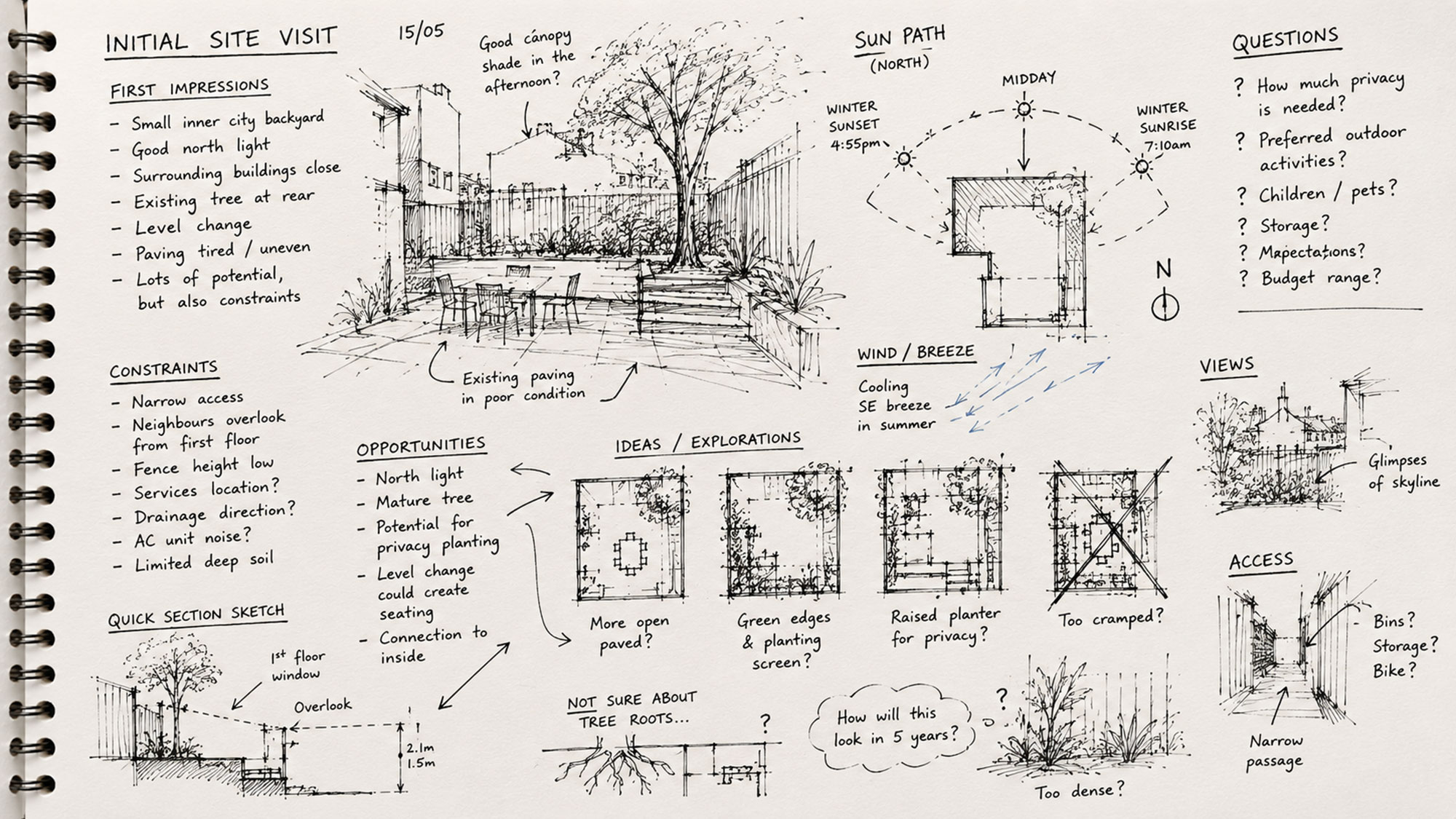
Many of the decisions that have the greatest influence on the outcome are made long before any physical work begins. Priorities are established. Site constraints are identified. Opportunities are explored. Trade-offs are considered. Problems are solved while they are still relatively easy to change.
This planning phase is often less visible than construction, but it can have a significant influence on how well a landscape performs over the long term.
Whether the project involves a garden in Vaucluse, a bushland-edge site in Lane Cove or a terrace in Balmain, the process typically begins with understanding rather than building.
Understanding the site, the people who will use it and the problems the project is intended to solve.

Why Planning Matters
It is easy to view planning as a preliminary step that simply happens before the real work begins.
However, planning is often where the most important decisions are made.
A homeowner may know they want more privacy, additional planting or a better space for entertaining. What is often less clear is how those objectives interact with existing site conditions, practical constraints and available budget.
For example, increasing privacy may affect sunlight. Additional planting may reduce usable space. Expanding an entertaining area may influence drainage, access or future maintenance requirements.
These relationships are not always obvious at the outset.
Planning provides an opportunity to understand how different decisions may affect one another before construction begins.
It also helps establish realistic expectations about what is achievable within the opportunities and constraints of a particular site.
This does not mean every detail must be resolved before work starts. Landscape projects will always involve some uncertainty.
However, the clearer the objectives, constraints and priorities become during planning, the easier it becomes to make informed decisions throughout the project.
Planning is not a delay before the project starts.
Planning is where the project starts.
Understanding What You’re Trying To Achieve
Many landscape projects begin with a problem.
The garden may lack privacy. Outdoor spaces may feel disconnected from the house. Maintenance may be becoming difficult. The space may simply no longer support the way the household wants to live.
In some cases, the problem is obvious.
In others, homeowners know something is not working but struggle to identify exactly why.
This is one reason the earliest stages of a project often focus on objectives rather than solutions.
A homeowner may initially request screening, paving or new planting. These may ultimately form part of the solution, but they do not necessarily explain the problem.
For example, a request for screening may actually be driven by privacy concerns. A request for paving may stem from difficulties maintaining an existing lawn. Additional planting may be intended to improve outlook, reduce overlooking or create a greater sense of enclosure.
Understanding the underlying objective often creates more opportunities than focusing immediately on a specific solution.
Priorities are also important.
Most projects involve multiple objectives that compete for limited space, budget or attention. Entertaining, privacy, planting, storage, maintenance and visual appeal may all be desirable, but they do not always coexist without compromise.
Understanding which outcomes matter most provides a foundation for better decision-making later in the process.
Many homeowners are not simply seeking a new landscape.
They are seeking confidence that the decisions they make will be the right ones for their site and circumstances.
Understanding The Site
Once project objectives are understood, attention can shift to the site itself.
Every property presents a unique combination of opportunities and constraints.
Aspect, sunlight, shade, drainage, access, existing vegetation and neighbouring properties all influence what is realistically achievable. Planning controls, heritage considerations and tree protection requirements may also shape future decisions.
A property in Vaucluse may enjoy expansive views and strong connections to the surrounding landscape. Those same qualities may also influence privacy, exposure to wind and how outdoor spaces are used throughout the year.
Understanding these conditions is not simply a process of collecting information.
The goal is to understand how the site may influence future decisions.
For example, a homeowner may want dense screening for privacy. Whether that is achievable depends partly on available space, sunlight, neighbouring buildings and the long-term growth characteristics of potential planting.
Similarly, a desire for more entertaining space may be influenced by drainage, circulation routes, existing trees or level changes across the site.
Good planning begins with understanding the realities of a site rather than assuming that every idea will work equally well everywhere.

Identifying Opportunities And Constraints
Understanding a site is only the first step.
The next step is understanding what those conditions mean.
This is where opportunities and constraints begin to emerge.
A site in Lane Cove may back onto bushland or contain significant existing vegetation. While this can contribute character, shade and habitat value, it may also influence planting opportunities, access and long-term maintenance considerations.
Many homeowners view constraints as problems to overcome.
In practice, constraints often become the starting point for good solutions.
A shaded garden may not support a sun-loving planting scheme, but it may create opportunities for a cooler and more comfortable outdoor environment. Limited space may prevent the inclusion of every desired feature, but it can also encourage greater clarity about priorities.
This is one reason successful landscapes often feel appropriate to their setting.
They respond to the realities of the site rather than attempting to ignore them.
Exploring Options And Trade-Offs
Once objectives, opportunities and constraints are understood, different options can be explored.
This stage is rarely about identifying a single perfect solution.
Most landscape projects involve trade-offs.
Improving privacy may reduce sunlight. Increasing planting may reduce usable space. Expanding an entertaining area may influence available budget or future maintenance requirements.
Even seemingly simple decisions can have multiple implications.
For example, screening may improve privacy while affecting views, airflow and the perception of spaciousness. Additional paving may increase functionality while reducing planting opportunities and stormwater infiltration.
A homeowner in Bellevue Hill may wish to maximise outdoor entertaining space while preserving established planting and maintaining visual connections to the surrounding landscape. Achieving one objective may influence the others, requiring priorities to be carefully balanced.
Budget also becomes increasingly relevant during this stage.
Different approaches may achieve similar outcomes while requiring different levels of investment. Likewise, some objectives may need to be prioritised over others to align with available resources.
Exploring these trade-offs before construction begins helps homeowners understand the implications of different choices and make decisions with greater confidence.
There is rarely a perfect solution.
There is usually a solution that represents the most appropriate balance between competing requirements.

Making Informed Decisions
As options are explored, uncertainty begins to reduce.
Objectives become clearer. Constraints become better understood. Trade-offs become more visible.
This is where informed decision-making becomes possible.
Many of the most important project decisions are not about selecting materials or choosing plants. They are about understanding the likely consequences of different approaches before committing to them.
A homeowner may discover that achieving complete privacy requires sacrificing winter sunlight. Another may find that preserving a mature tree limits the size of a proposed entertaining area. These are not necessarily problems, but they are decisions that benefit from careful consideration.
The goal is not to predict every possible outcome.
Rather, it is to understand enough about the site, objectives and available options to move forward with confidence.
By this stage, many homeowners have gained something valuable.
Not necessarily a completed plan, but a clearer understanding of what they are trying to achieve and the most appropriate path towards it.
Preparing For Construction
Only after objectives, constraints and key decisions have been explored does construction preparation typically begin.
Depending on the project, this may involve documentation, specifications, approvals or coordination with contractors and suppliers.
It is often tempting to think of plans and drawings as the beginning of a project.
In reality, they are frequently the outcome of the thinking that has occurred beforehand.
The purpose of documentation is not simply to record decisions.
It is to communicate them clearly so that construction can proceed with fewer misunderstandings and fewer surprises.
The more clarity that exists before construction begins, the easier it becomes to implement decisions consistently throughout the project.

What Homeowners Can Do Before Seeking Advice
Homeowners do not need to solve every problem before seeking professional advice.
However, a small amount of preparation can be valuable.
Before beginning a landscape project, consider:
- What problems are you trying to solve?
- What currently works well?
- What currently does not work well?
- Which priorities are most important?
- How do you want the space to function?
- Are there any known site constraints?
- How might your needs change over time?
Answering these questions can help create more productive discussions and provide a clearer foundation for future decisions.
It can also help distinguish between the outcomes you want to achieve and the specific solutions that may eventually support them.
Wrap Up
Construction may be the most visible stage of a landscape project, but it is rarely where the most important decisions are made.
Long before materials arrive on site, time is often spent understanding objectives, analysing conditions, identifying opportunities, exploring trade-offs and reducing uncertainty.
This planning phase helps establish the clarity needed to make informed decisions throughout the project.
Whether the project involves a small courtyard, a terrace garden or a larger residential landscape, the most successful outcomes rarely begin with construction.
They begin with understanding.
Frequently Asked Questions
What happens before landscape construction begins?
Before construction begins, homeowners typically work through a planning phase that involves understanding project objectives, assessing site conditions, identifying opportunities and constraints, exploring options and making key decisions about the direction of the project.
Why is site analysis important?
Site analysis helps identify the opportunities and constraints that may influence future decisions. Factors such as sunlight, drainage, access, existing trees and planning controls can all affect what is realistically achievable.
Do I need a landscape plan before speaking with contractors?
Not always. However, having a clear understanding of objectives, priorities and site conditions before construction discussions begin can help reduce uncertainty and improve decision-making.
How long does the planning phase take?
This varies between projects. Simpler projects may progress relatively quickly, while more complex sites or projects with multiple competing requirements may require additional investigation and decision-making.
Can planning help reduce costly changes during construction?
Yes. While no project can eliminate uncertainty entirely, exploring options and resolving key decisions before construction begins can help reduce the likelihood of significant changes later in the project.
What should I do before seeking professional advice?
Start by identifying the problems you are trying to solve, the outcomes you hope to achieve and any known constraints affecting the site. This information can provide a useful foundation for future discussions.
Need Clarity Before You Commit?
Every landscape project begins with a unique combination of site conditions, opportunities, constraints and client objectives.
Before making significant decisions, it can be valuable to understand how these factors interact and where the key trade-offs may exist.
A Jasper Green Site Diagnostic is designed to help homeowners identify opportunities, clarify priorities and understand potential constraints before committing to major landscape investment.
Whether you’re planning a courtyard renovation, a front garden transformation or a larger landscape project, early clarity can help reduce uncertainty and support better decision-making throughout the process.

Looking to make informed decisions?