
Why Site Analysis Matters More Than Plant Selection
When people begin thinking about a new garden, one of the first questions is often: what should I plant?
It is an understandable place to start. Plants are one of the most visible parts of a landscape. You might already have favourite species, saved images of gardens you like or an idea that you need a hedge, a feature tree or a particular style of planting.
But plant selection comes later than many people expect.
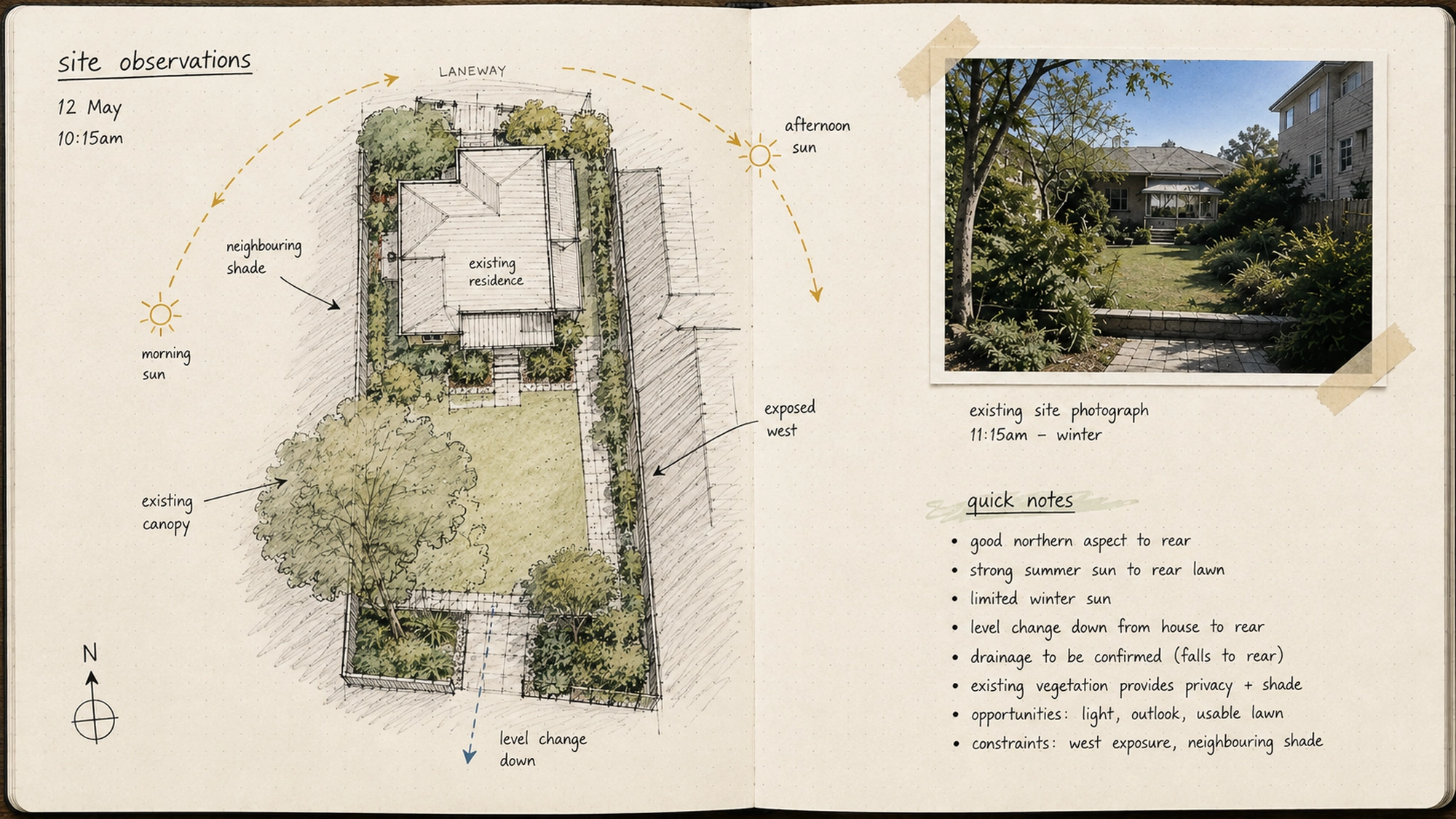
Before deciding what belongs in a landscape, we first need to understand what that landscape needs to respond to. The soil beneath it. The movement of sun and shade. Drainage and levels. Existing vegetation. Neighbouring buildings and trees. Access, exposure, privacy and planning constraints.
And then there are the people who will use it.
Good landscape decisions emerge from understanding these conditions together. Plant selection is important, but it is one of the decisions that follows that understanding rather than a substitute for it.

Before asking what to plant, ask what is happening on the site
Every property contains information that can influence the landscape.
Some of it is obvious. A steep slope, an established tree or a neighbouring building casting afternoon shade can be difficult to miss. Other conditions may only become significant once you begin considering what you want to do with the property.
This is where site analysis matters.
The NSW Department of Planning describes site analysis as part of planning and designing development. Its guidance considers not only the property itself, but adjoining land and the surrounding streetscape, identifying characteristics such as solar access, existing buildings and trees, privacy, overshadowing, slope and drainage. Its guidance makes the principle particularly clear: “Site analysis is the key to good design.”
The purpose, however, is not simply to compile a list of site characteristics.
Knowing that a garden slopes tells us something about the property. Understanding what that slope means for drainage, circulation, construction or the way different areas can be used begins to tell us something about the project.
That distinction matters. Site information becomes valuable when we understand its implications for the decisions that follow.
“Suitable for Sydney” isn’t specific enough
Plant descriptions often tell us that a species is suitable for Sydney, a temperate climate, full sun or a particular soil type.
Those descriptions are useful, but they are only a starting point.
Sydney itself contains significantly different growing conditions.
NSW Environment and Heritage broadly identifies Sydney soils as including sandy soils derived from sandstone and clay soils derived from shale or volcanic rocks, as well as mixtures of the two. Soil pH and drainage vary as well, and these differences affect which plants are likely to perform successfully.
Conditions can also vary considerably above ground.
Research by the City of Sydney into summer microclimates demonstrates just how local those differences can become. At 12:40pm on 9 December 2023, monitoring recorded an air temperature of 45.3°C at Church Street in St Peters. At exactly the same time, the Royal Botanic Garden, only 6.4 kilometres away, recorded 30.0°C.
That is a 15.3°C difference between two measurements within the same city.
It should not be interpreted as a typical temperature difference between Sydney gardens. It does demonstrate something important: local conditions matter. The City found hotter locations were generally associated with factors such as limited tree canopy, dense development and extensive hard surfaces, while major green spaces recorded lower temperatures.
The same principle operates at the scale of an individual property.
A west-facing courtyard surrounded by masonry and paving may experience very different summer conditions from a sheltered garden a few suburbs away, a street away or even on a neighbouring property, even though both are technically in the same climate region.
A plant can therefore be suitable for Sydney in general and poorly suited to the conditions of a particular Sydney garden.

Site conditions rarely act alone
Even understanding individual conditions is not enough. They interact.
Imagine a plant described as suitable for full sun. That tells us something useful, but not whether it will perform well beside a west-facing masonry wall where paving and building surfaces intensify afternoon heat.
A screening plant may tolerate shade, but the proposed planting area might also contain restricted soil volume and competition from the roots of an established neighbouring tree.
A tree might suit the site’s climate and soil, but getting mature stock into a constrained inner-city backyard could be impractical.
None of these conditions necessarily determines the answer on its own.
This is why landscape analysis is different from matching plants against individual criteria. Sunlight, soil, drainage, exposure, available space, existing vegetation and the built environment form a set of interacting conditions.
The relevant question becomes not simply Can this plant grow in sun? but What conditions actually exist here, and what do they mean when considered together?
Gardening Australia’s familiar principle of putting the “right plant in the right place” captures the horticultural consequence well. Its plant-selection guidance recommends considering climate, rainfall, temperature, soil, light and available space rather than choosing plants in isolation.
Landscape design takes that thinking further because planting is only one component of the project.

The site doesn’t stop at the boundary
The title boundary on a survey tells us where a property begins and ends. It does not contain all the influences acting on the landscape.
This is particularly apparent in established Sydney suburbs, where properties often sit within a dense network of buildings, mature trees, walls, neighbouring gardens and streets.
A building next door may determine when part of the garden receives direct sunlight. A neighbouring tree can provide valuable canopy while also influencing shade, soil moisture and the space available for new planting. Differences in ground level can affect overlooking and privacy. Street trees can contribute shade and landscape character well beyond the front boundary.
NSW Planning guidance recognises this wider context explicitly. Its approach to site analysis includes adjoining properties and the streetscape, including neighbouring buildings and trees, privacy and overshadowing.
The implication is straightforward:
A property boundary defines ownership. It does not necessarily define the environmental or design influences acting on a garden.
Understanding context therefore matters just as much as understanding what exists within the fence.
A constraint isn’t necessarily a problem
Site analysis is sometimes imagined as a search for problems: poor drainage, difficult access, unwanted shade, awkward levels.
That is only half the picture.
Every site contains opportunities as well as constraints, and sometimes the same characteristic can be both.
Consider an established mature tree.
Its root system and canopy might restrict excavation, construction or the location of certain new elements. Shade beneath it may rule out plants that require prolonged direct sun.
But that same tree might already provide something that would take decades to recreate: summer shade, established canopy, habitat, scale and landscape character.
Removing the “constraint” could therefore mean removing one of the site’s most valuable assets.
The purpose of understanding a site is not to eliminate everything that makes design difficult. It is to determine what should be accommodated, what can be used to the project’s advantage and where genuine limitations need to influence the response.
Constraints often help define the problem. Opportunities help reveal what is already worth working with.
Understanding the site is only half the equation
A detailed understanding of a property still cannot determine the right landscape on its own.
The site tells us about the conditions a landscape needs to respond to. The client tells us what that landscape needs to achieve.
One household might need an outdoor space capable of accommodating young children. Another might prioritise entertaining, privacy or low maintenance. Pets, accessibility, sensitivities, maintenance expectations and the way people actually move through and use their home can all influence decisions.
The physical site could be identical in each case. The appropriate landscape response would not necessarily be.
This is where professional judgement becomes important.
Landscape decisions need to bring together the conditions of the site with the objectives and practical requirements of the people who will use it. Neither can be considered properly in isolation.
Site conditions establish the context. Client requirements establish the purpose. The design response needs to resolve both.

When compliance isn’t the whole picture
A recent Jasper Green project demonstrated this distinction particularly clearly.
The homeowners asked us to review a landscape plan that formed part of an already approved development application. The plan had been professionally prepared by another firm, and responded to the relevant planning requirements and arborist report.
But the homeowners had not been consulted by the firms landscape architects during its preparation, and the property itself had not been visited as part of developing the planting scheme.
Once the proposed landscape was considered against the actual conditions of the property and the requirements of the people who would live there, additional issues became apparent.
Planting had been specified in an area exposed to strong, hot afternoon sun despite the specified planting being poorly suited to those conditions. The homeowners also had personal requirements relevant to plant selection, including asthma, that could not have informed the original palette because they had never been consulted.
The point is not that the approved plan failed to satisfy its regulatory purpose. It had responded to the information and requirements it had been prepared to address.
The problem was that those requirements did not represent the whole landscape problem.
Planning compliance answers an important set of questions. It does not, by itself, establish whether a landscape response is appropriate for the particular site and the particular people who will live with it.
That requires a broader understanding.
What happens when solutions come first
Choosing solutions before developing that understanding introduces uncertainty.
Sometimes the consequence is relatively simple: a plant needs to be changed once its actual growing conditions are understood.
Sometimes the implications extend further.
A desired tree location may conflict with existing site conditions. A paved entertaining area may need reconsideration once levels and drainage are understood. A screening strategy may change when neighbouring vegetation, solar access and available soil volume are considered together. A landscape proposal may need adjustment when an overlooked planning requirement becomes apparent.
These discoveries do not necessarily mean something has gone badly wrong.
The issue is sequence.
When important information appears after a solution has already been selected, the project has to respond retrospectively. That can mean compromise, redesign, additional cost or a landscape that performs less successfully than it could have.
Investigating first reduces that uncertainty.
Better landscape decisions begin with better questions
Plant selection matters.
Plants shape the character, ecology, comfort and long-term performance of a garden. Choosing them well requires horticultural knowledge and an understanding of how they will develop over time.
But What should I plant? is rarely the most useful first question.
Start further back.
- What is happening here?
- What do the people using this landscape need from it?
- What do those things mean when considered together?
- Only then does the next question become useful:
- What should we do?
That shift—from searching immediately for solutions to first understanding the problem—is fundamental to good landscape design.
The result is not simply a better plant list. It is a landscape in which planting, layout, materials and other decisions can be made in response to the particular conditions and requirements of the project.
Site Diagnostic
Jasper Green’s Site Diagnostic establishes an informed understanding of a property before design decisions are made. It investigates the conditions, opportunities and constraints influencing the landscape so that the next stage of the project can proceed with greater clarity.
Learn about the Site Diagnostic.
Frequently asked questions
What is site analysis in landscape design?
Site analysis is the process of understanding the existing conditions and context of a property before developing landscape recommendations. It can include physical and environmental characteristics, existing vegetation, neighbouring influences and relevant planning considerations. Its value lies not simply in identifying these conditions, but in understanding what they mean for the project.
Should site analysis happen before choosing plants?
Yes. Plant selection depends on conditions including soil, drainage, sunlight, exposure, available space and surrounding vegetation. Understanding those conditions first allows plants to be selected in response to the site rather than relying on general suitability or appearance alone.
What site conditions affect landscape design?
Relevant conditions vary from property to property. They can include topography, soil, drainage, sunlight and shade, microclimate, existing trees and vegetation, neighbouring development, access, privacy, views and regulatory constraints. The important consideration is how the conditions relevant to a particular property interact and influence the decisions being made.
Why can growing conditions vary across Sydney?
Sydney contains different soil landscapes, topography, vegetation patterns and forms of urban development. At a local level, tree canopy, buildings, paving, orientation, shade and exposure can create different microclimates between suburbs and even between areas of the same property. This is why general descriptions such as “suitable for Sydney” cannot replace understanding the conditions of an individual site.

If you are ready to see how site analysis can improve your property or landscape project find out more about our Site Diagnostic service.